
The Time Tax
Your agency is giving away billable time.Here's where it goes.
Put a number on the margin you lose to late, missing and unbilled hours, in under a minute. Built on data from 233 agency workspaces.
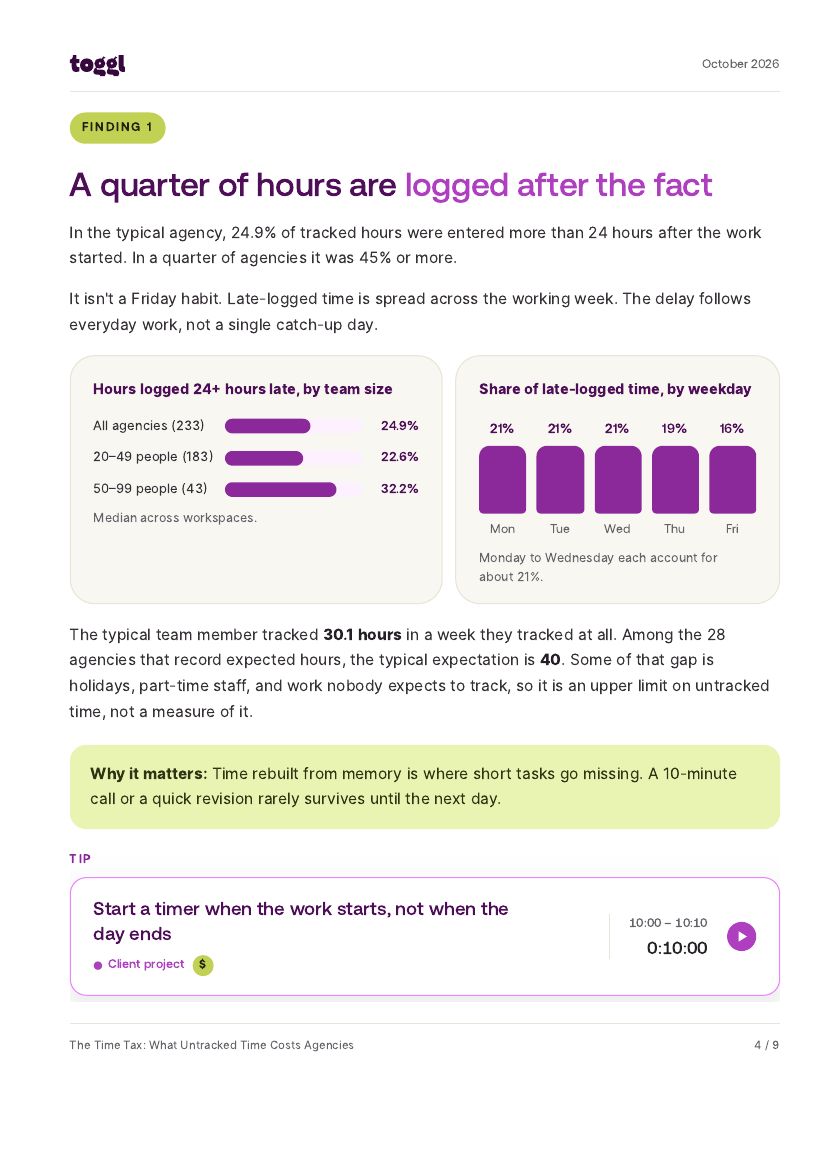
Agencies in our data entered 24.9% of hours more than a day after the work started.
Time Tax calculator
Your inputs
Where to find yours: People doing billable work.
Where to find yours: Your utilization target × working hours.
Where to find yours: Your blended rate across roles. Median in our data: $115/hour, across 149 agencies that set rates.
Your estimated Time Tax
Your agency is giving away
$431,250
a year in time it never bills.
1 in 10
billable hours never invoiced
2.5
full-time people working for free
10%
of potential billable revenue lost
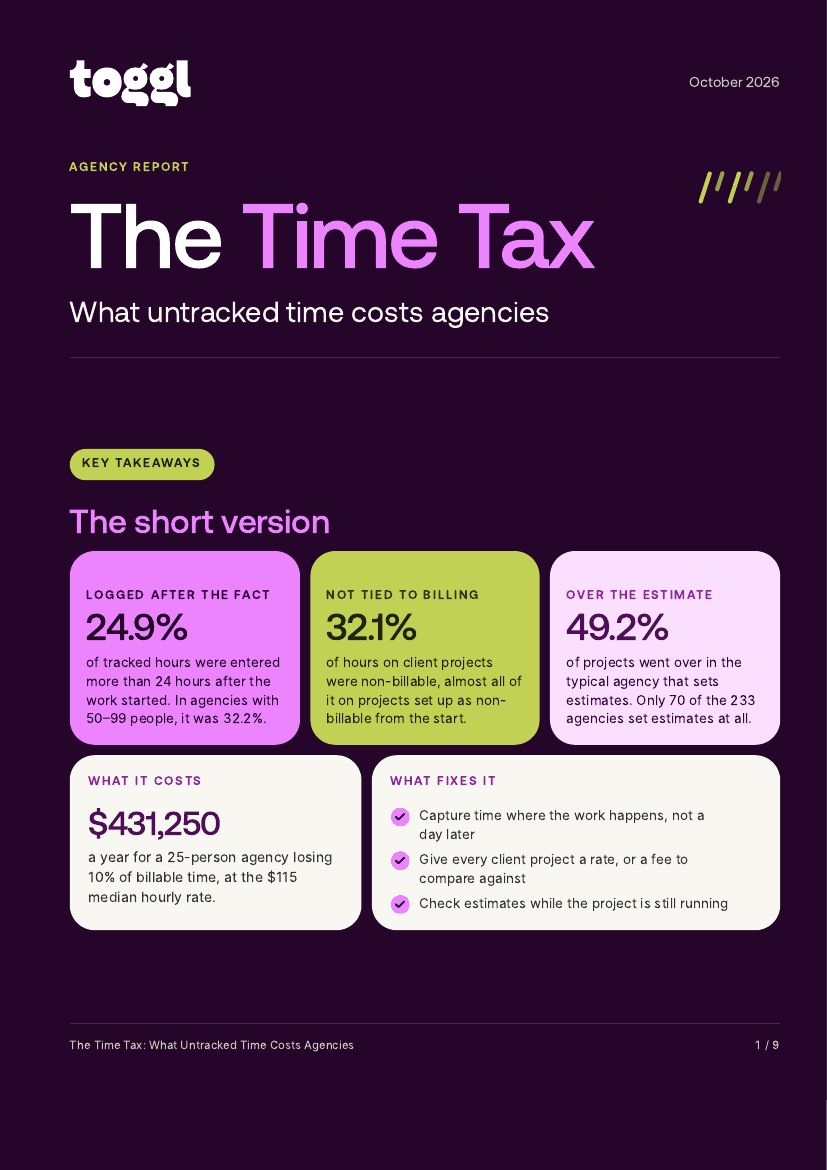
25 people × 1,500 hours × 10% = 3,750 hours. 3,750 hours × $115 = $431,250.
The calculation is simple on purpose. Team size and the 10% are example inputs; use your own.
Bring your own workflow. In 30 minutes, a Toggl specialist walks through how your team actually works and shows you where Toggl cuts the Time Tax.
Sound familiar?
Friday, 5pm
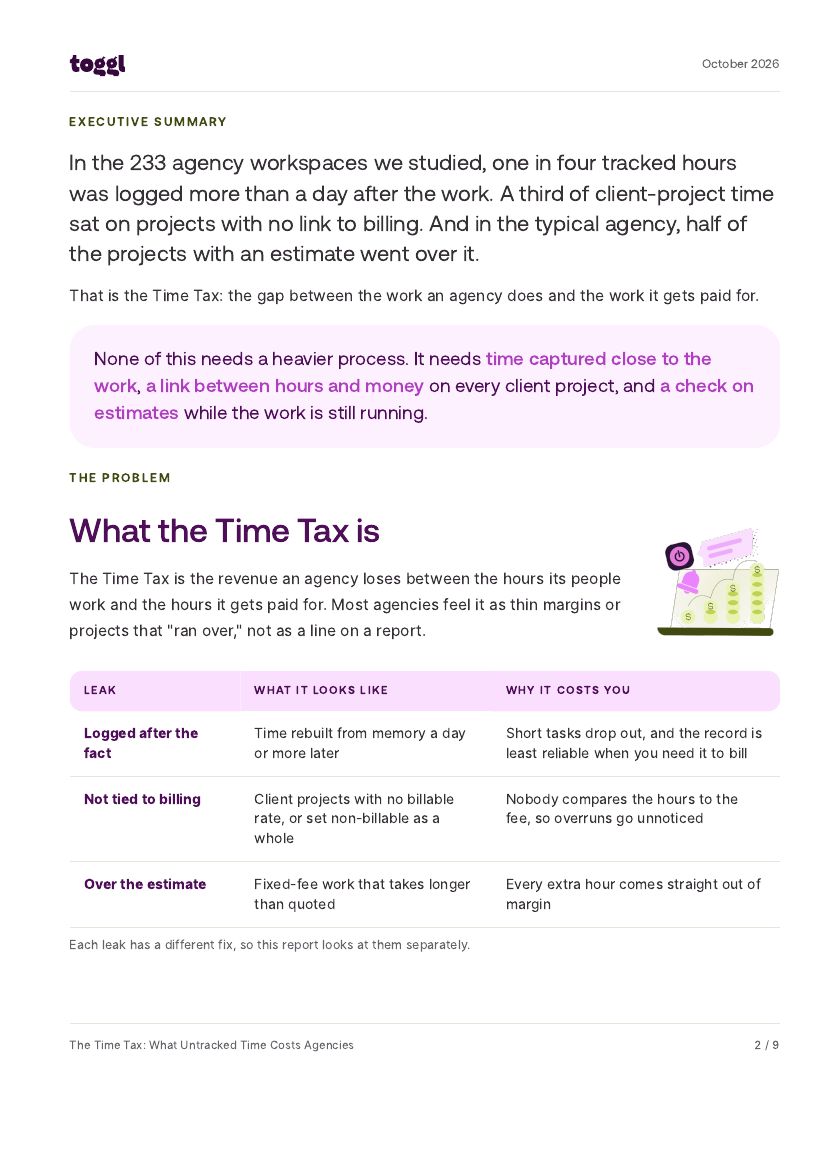
Someone rebuilds the week's timesheet from Slack, email and their calendar. The 15-minute client calls don't make it in.
A quarter of tracked hours are entered over a day late.
Month-end
The retainer looks healthy on paper. Then you see the team spent 30 hours on a 22-hour account, and none of it was billable.
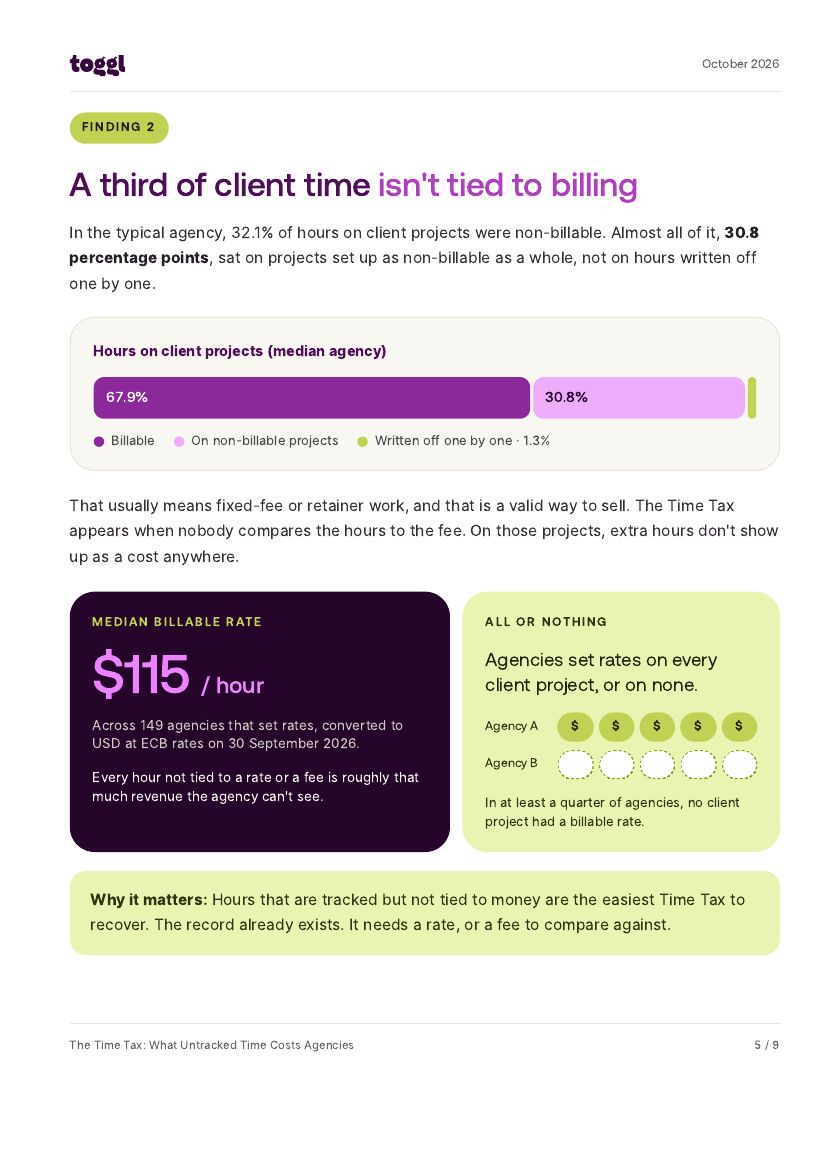
32.1% of hours on client projects are non-billable.
The post-mortem
The fixed-fee project went over again. Nobody saw it coming because nobody set an estimate to compare against.
Half of projects go over in agencies that set estimates.
What the data shows
24.9%
of tracked hours were entered more than 24 hours after the work started. In agencies with 50-99 people, it was 32.2%.
32.1%
of hours on client projects were non-billable, almost all of it on projects set up as non-billable from the start.
49.2%
of projects went over in the typical agency that sets estimates. Only 70 of the 233 agencies set estimates at all.
Source: Toggl data, 233 agency workspaces, September 2025 to September 2026. Medians across workspaces.
If you run the agency
- See which clients and retainers actually make money.
- Price new work from real hours, not gut feel.
- Win back margin without adding headcount.
If you run operations
- Stop chasing people for timesheets every Friday.
- Spot retainers running over before month-end.
- Watch workload so nobody burns out quietly.
How agencies cut the Time Tax
Capture time where the work happens: a timer in the browser, the project tool, or the calendar, not a timesheet filled in later.
Give every client project a billable rate, or a fee to compare hours against.
Set a time estimate on every fixed-fee project and compare tracked hours to it while the project is running.
See what this looks like for your team.
A Toggl specialist will walk through your workflow and show where these fixes fit.
Customer story · Talk Shop Media
Before, we were chasing up to 15% of our workforce to complete their timesheet. When we switched to Toggl, people actually started tracking their time.
Hannah McClenaghan · Operations Manager · 50-person PR & marketing agency
60-80
hours a month saved on time tracking
90%
of the team now logs their hours
50%
less time spent tracking than their old tool
Get the full Time Tax report
Nine pages: the three leaks, the data behind them, and an eight-step way to find your own Time Tax this quarter.
Page 1 of 5 · preview
About the data
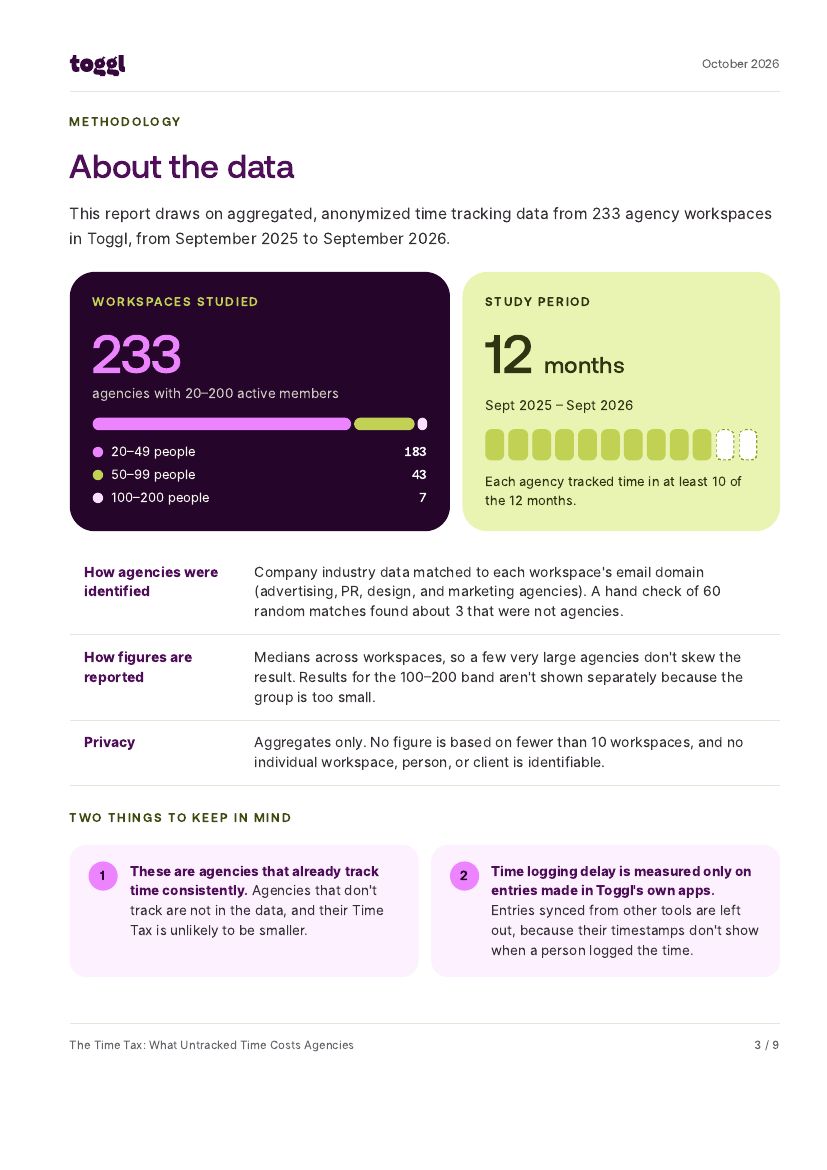
This report draws on aggregated, anonymized time tracking data from 233 agency workspaces in Toggl (20-200 active members), September 2025 to September 2026. These are agencies that already track time consistently, so agencies that don't track aren't in the data. Late-logging is measured only on entries made in Toggl's own apps. No figure is based on fewer than 10 workspaces.